Proportion of population who identify as LGBTIQA+
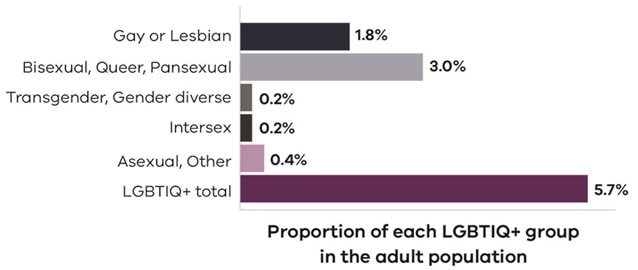
In the 2017 Victorian Population Health Survey, 5.7 per cent of respondents identified as lesbian, gay, bisexual, trans and gender diverse, intersex, queer and asexual (Victorian Agency for Health Information - unpublished), with the relative proportion of each subgroup summarised in Table 1:
Table 1: Proportion (%) of the adult population, by LGBTIQA+ status, Victoria, 2017
| LGBTIQA+ group | Sample size (n) | Proportion (%) of adult population by LGBTIQA+ status |
|---|---|---|
| Gay or Lesbian | 458 | 1.8 |
| Bisexual, Queer, Pansexual | 616 | 3.0 |
| Transgender, Gender diverse | 41 | 0.2 |
| Intersex | 57 | 0.2 |
| Asexual, Other | 128 | 0.4 |
| TOTAL LGBTIQA+ | 1,300 | 5.7 |
Health and wellbeing indicators for LGBTIQA+ Victorians
Data from the survey shows that LGBTIQA+ Victorian adults experience poorer health and wellbeing than heterosexual, non-LGBTIQA+ Victorians (Victorian Agency for Health Information - unpublished).
A summary of indicators for LGBTIQA+ Victorians shows that a significantly higher proportion of LGBTIQA+ adults:
- had low to medium life satisfaction and a feeling of life being worthwhile, compared with the heterosexual, non-LGBTIQA+ adult population
- had moderate, high or very high levels of psychological distress, compared with the heterosexual, non-LGBTIQA+ adult population
- were diagnosed with anxiety or depression, compared with the heterosexual, non-LGBTIQA+ adult population
- had an experience of family violence, compared with the heterosexual, non-LGBTIQA+ adult population
- had an experience of discrimination, compared with the heterosexual, non-LGBTIQA+ adult population.
In addition, a significantly lower proportion of LGBTIQA+ adults could get help from relatives or friends in an emergency, or from family and neighbours when required, compared with the heterosexual, non-LGBTIQA+ adult population.
Victorian Government initiatives
Since late 2014, the Victorian Government has invested more than $60 million in initiatives that make the community fairer and promote equality for LGBTIQA+ Victorians.
This includes $15 million towards Australia's first Pride Centre, $4 million in grants for LGBTIQA+ community organisations and $5.3 million to support LGBTIQA+ people experiencing, or at risk of, family violence.
Funding has been provided to statewide LGBTIQA+ support service Switchboard Victoria to pilot suicide prevention programs across the state. Victoria has also boosted LGBTIQA+ family counselling services.
Laws to prohibit LGBTIQA+ conversion practices will be enacted, ending the practice that has caused trauma to many Victorians.
Find out more
The State of Victoria’s children reports(opens in a new window) have more information on bullying experienced by young LGBTIQA+ Victorians and their mental health.
Access the Chief Health Officer page on PrEPX and HIV for information about pre-exposure prophylaxis and HIV.
References
Victorian Agency for Health Information - unpublished, The health and wellbeing of the lesbian, gay, bisexual, transgender, intersex, queer population in Victoria: a short summary, Victorian Agency for Health Information, Melbourne.
Updated