Key messages
- Examine prescriptions critically and do not assume that a prescription is genuine.
- Pharmacists may be prosecuted for dispensing fraudulent prescriptions if they have failed to comply with legislative and professional requirements before doing so.
- Record all communications with prescribers.
- Ask for patient (or agent) identification when atypical or suspicious prescriptions are presented.
Most prescriptions will be from familiar prescribers and/or for typical quantities of a medicine. When presented with a prescription that is inconsistent with a pharmacist's experience, especially for medicines that are subject to misuse, abuse and profitable diversion, the pharmacist should attempt to determine why the prescription is atypical. They must comply with their legislative and professional responsibilities and assess whether it is safe, appropriate and lawful to dispense the prescription.
Pharmacists must not assume that a prescription has been issued by an appropriately registered health practitioner because:
- the prescription does not look suspicious
- it is a computer-generated prescription
- it is a PBS authority prescription
- it is approved by PBS online
- it is a hospital prescription
- similar prescriptions have been dispensed for the patient and are shown as dispensing events on SafeScript.
Fraudulent prescriptions have been dispensed in each of these situations because pharmacists did not comply with regulation 51(2). This regulation makes it an offence for a pharmacist to supply more than 2 days’ supply of a Schedule 8 poison unless:
- the pharmacist is familiar with the purported prescriber's handwriting
- and the writing on the prescription is comparable to the usual writing of the purported prescriber
- or the pharmacist has taken all reasonable steps to verify that the prescription was written by the purported prescriber.
This regulation applies to both PBS and non-PBS prescriptions.
What to do after receiving a fraudulent prescription
After confirming that a prescription is fraudulent, report it to the Department by completing the Notification of forged or altered prescription form.
Provide relevant information, including:
- a copy of the prescription
- a still image (from CCTV footage) of the person who presented the prescription (if possible)
- any information that might be useful in identifying the person, such as drivers licence details, description of car and licence plate number
- the name and badge number (or email address) of the police officer to whom the matter was reported.
If you dispensed a fraudulent prescription for a monitored medicine:
- if the medication was supplied, do not cancel the dispensing event
- replace the previously recorded ‘Dosage Instructions’ (if any) in the pharmacy dispensing records so that the corresponding record on SafeScript contains information that might alert another pharmacist about the possibility of a fraudulent prescription
- make the information as prominent as possible by using UPPER CASE letters and describe the situation in clear concise terms, for example: HANDWRITTEN PRESCRIPTION CONFIRMED AS FRAUDULENT BY THE PURPORTED PRESCRIBER.
Current and recent alerts
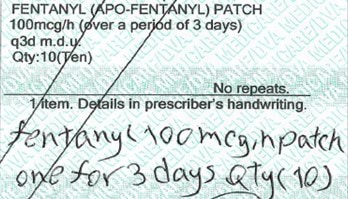
Examples of other prescription scams
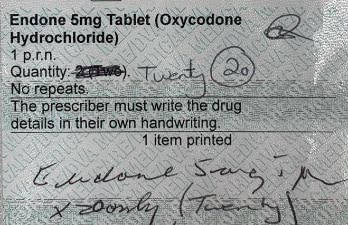
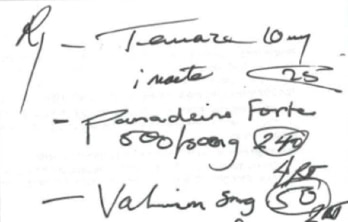
In some of the following examples, pharmacists were prosecuted for failing to comply with their legislative responsibilities.
Advice
Do not rely on SafeScript as evidence that a prescription is lawful (or unlawful)
- A dispensing event on SafeScript proves only that a previous prescription was dispensed; it does not prove that the previous prescription was legitimate.
- Whereas a prescribing event on SafeScript might prove that a prescription was issued by a particular prescriber, it does not prove that a prescription presented at a pharmacy is the same prescription; it could be a scanned copy.
- The absence of a prescribing event on SafeScript does not prove that a prescription is fraudulent; many clinics do not yet transmit prescribing information to SafeScript and handwritten prescriptions are never transmitted.
Do not rely on PBS Online as evidence that a prescription is lawful
- Fraudulent prescriptions, including PBS Authority prescriptions and repeat prescriptions, have frequently been dispensed by pharmacists who falsely believed that PBS Online would serve a function for which it is not intended.
Examine all prescriptions critically
- Spelling mistakes (or similar errors) on a prescription should raise a pharmacist’s suspicion, especially where a computer-generated prescription is involved.
- Prescribers must not make manual amendments to computer-generated prescriptions. Any such amendments should be viewed with suspicion and the prescriber should be contacted.
Compare prescribers' handwriting
- Comparing a forged prescription with a similarly forged prescription, which was previously dispensed at the pharmacy, is unlikely to reveal a forgery. Some pharmacies retain filed copies of prescriptions which have been confirmed by prescribers, for comparison purposes.
Keep notes of communications with prescribers
- Recording all communications with prescribers (and unsuccessful attempts to contact a prescriber) makes it less likely that a colleague will falsely assume that such a communication has occurred.
Ask for identification
- Many offenders create fraudulent prescriptions using a false name or another person’s name. When asked to provide identification, the response or excuses offered can fuel an existing suspicion. If an appropriate form of photo identification is provided, it can serve to subsequently identify an offender.
Be aware of stolen and forged prescriptions
- Many offenders attend pharmacies at times when it is difficult to contact prescribers. The department’s website contains frequently updated details of practitioners whose names have been associated with forged and stolen prescriptions. It is recommended that pharmacies have the relevant web page bookmarked so that it can be quickly referenced.
Updated